Begun, the Dupe Wars Have

The term “dupe” can carry different meanings in different contexts, but it has increasingly become the label for a product that imitates the appearance, aesthetic, or functionality of a branded product without copying the brand itself. Dupes have occupied the attention of brand owners for years, but lululemon’s October 21, 2025, registration of LULULEMON DUPE may signal something more ambitious: a direct challenge to dupe culture itself. The registration raises a fundamental question: can brands claim exclusive rights in the language consumers use to identify lookalike products?

Three years ago, lululemon launched its two-day “Dupe Swap” event at Los Angeles’s Century City Mall on May 6-7, 2023, inviting consumers to trade in lookalike leggings for authentic Align leggings. Eighteen months later, on November 25, 2024, lululemon athletica canada inc., applied to register DUPE SWAP for a broad range of retail, advertising, marketing, and promotional services. That description appears difficult to reconcile with the limited, one-time legging exchange event that inspired the application. Instead, it encompasses advertising, marketing, and promotional activities that lululemon performed for itself in the ordinary course of business rather than services rendered for others.

Because the USPTO correctly viewed DUPE SWAP as descriptive of an event involving the exchange of dupes, the mark registered on the Supplemental Register rather than the Principal Register. Even so, the registration confers certain benefits, including the ability to use the ® symbol, assuming lululemon resumes use of the mark following the current three-and-one-half-year lapse in use.

Nine days after applying to register DUPE SWAP, on December 4, 2024, lululemon filed an application to register LULULEMON DUPE for essentially the same collection of retail, advertising, and promotional services. Unlike DUPE SWAP, this application matured into a Principal Register registration despite the absence of actual use in the United States. The registration was based on a Benelux registration that lululemon applied for only one day before filing the U.S. application, and which issued barely two months later, on February 12, 2025.

Obtaining a U.S. registration through Section 44(e) without actual U.S. use is entirely lawful. Nevertheless, the applicant must possess a bona fide intention to use the mark in U.S. commerce (15 U.S.C. § 1126(e), 37 C.F.R. § 2.34(a)(3)(i), and TMEP §§ 1004 and 1008). It is difficult to imagine any lululemon entity genuinely intending to use LULULEMON DUPE as a mark, much less actually doing so, raising questions regarding the nature and extent of the lululemon’s bona fide intent at the time of filing.

What, then, is lululemon’s battle plan for a registration of a mark it likely will never use? The most likely answer is that the registration will be used as a tool against sellers of dupes on Amazon, other online marketplaces, and perhaps even operators of websites devoted to identifying or selling dupe products. Whether those platforms will distinguish between trademark uses of LULULEMON DUPE and descriptive uses protected by the fair-use defense codified in 15 U.S.C. § 1115(b)(4) remains to be seen.

Other companies appear to be adopting a similar strategy. On March 11, 2025, Aritzia LP filed Application No. 99077257 for ARITZIA DUPE for bags, clothing, and retail store services. Williams-Sonoma entered the fray on April 20, 2026, applying to register POTTERY BARN DUPE for retail store and online retail store services featuring a wide variety of home furnishings and décor products. Like lululemon, Williams-Sonoma relied on a foreign registration obtained in remarkably short order.

Until it deploys its registration offensively, lululemon will likely continue relying on more traditional forms of intellectual-property protection. Indeed, in Lululemon Athletica Canada Inc. v. Costco Wholesale Corp., No. 2:25-cv-05864 (C.D. Cal. filed June 27, 2025), lululemon asserted design patent and trade dress rights. The case ultimately ended through a series of confidential settlements and stipulations, culminating in dismissal on August 11, 2026.

Where patents, copyrights, trademarks, or trade dress protect a product’s features, infringement claims properly exist against those who copy those protected elements. But where no intellectual-property right protects a product, copying should remain lawful. And if copying is lawful, competitors should ordinarily be free to describe what they have done, including by identifying their products as “dupes” of better-known alternatives. Allowing such descriptions may not only promote competition, but also reduce consumer confusion by accurately communicating the relationship consumers already perceive between the products.

Trademark Litigation in the Federal Courts

This chart shows the disposition of Federal Trademark Cases over the past ten years.  The claimant wins outright 28% of the time, but assuming satisfactory settlements, the claimant gets a favorable outcome 85% of the time.

Drilling down on these numbers:  About 15% of trademark cases end in a default.  It is interesting to note that only about 1.3% of trademark cases actually go to trial, and of these the trademark owner wins 73% of the time, and the accused infringer wins 27% of the time.  More trademark cases (2.1% of the total) are decided by summary judgment, with the trademark owner winning 57% of these, and the accused infringer winning 43% of these.

6ter Listings

Once in a while you stumble across an entry in the USPTO’s trademark database that is marked as pending despite a decades-old filing date, and which covers all the classes, without any description of good/services:

It turns out that these are 6ter Listings are made pursuant to 6ter of the Paris Convention under which members agreed not to register “armorial bearings, flags, and other State emblems, of the countries of the Union, official signs and hallmarks indicating control and warranty adopted by them, and any imitation from a heraldic point of view.” To facilitate the refusal, the USPTO enters them into the trademark database, even though they are not trademarks, so that Examiner’s can find them, and make the appropriate refusal.

These listings can be found by searching SN:89* in the USPTO trademark database. As of July 10, there are 3,194 such listings. They include listings from the U.S. government as well as from foreign governments.

TMEP 1205.02 explains:

1205.02 Article 6ter of the Paris Convention
The United States is a member of the Paris Convention for the Protection of Industrial Property, as revised at Stockholm on July 14, 1967, the members of which constitute a Union for the protection of industrial property. Paris Convention for the Protection of Industrial Property art. 6ter, Mar. 20, 1883, https://www.wipo.int/wipolex/en/text/288514 (accessed on March 25, 2025).

Under Article 6ter of the Paris Convention, the contracting countries have agreed to refuse or to invalidate the registration, and to prohibit the unauthorized use as trademarks or as elements of trademarks, of armorial bearings, flags, and other State emblems of the member countries, official signs and hallmarks indicating control and warranty adopted by member countries, and any imitation from a heraldic point of view. The provision applies equally to armorial bearings, flags, other emblems, abbreviations, and names of international intergovernmental organizations of which one or more countries of the Union are members, except for those that are already the subject of international agreements in force, intended to ensure their protection (e.g., “Red Cross” and emblems protected by the Geneva Convention of August 12, 1949).

Under Article 6ter, each member country or international intergovernmental organization (IGO) may communicate armorial bearings, emblems, official signs and hallmarks indicating warranty and control, and names and abbreviations of IGOs to the IB, who will transmit the communications to the other member countries. Within twelve months from receipt of the notification, a member country may transmit its objections, through the IB.

When the USPTO receives notifications from the IB under Article 6ter, the USPTO searches its records for conflicting marks, although the requests are not subjected to a full examination by an examining attorney or published for opposition. If the USPTO determines that a designation should be entered into the USPTO search records to assist USPTO examining attorneys, the designation is assigned a serial number in the “89” series code (i.e., serial numbers beginning with the digits “89,” sometimes referred to as “non-registrations”). Information about the designation should be discovered in an examining attorney’s search.

Refusal of Marks Notified Under Article 6ter

Depending on the nature and use of the mark, §§2(a) and 2(b) of the Trademark Act, 15 U.S.C. §§1052(a) and 1052(b), may bar registration of marks comprised in whole or in part of designations notified pursuant to Article 6ter and to which the United States has transmitted no objections. A refusal under §2(d) of the Trademark Act is not appropriate. The issue is not whether the marks are confusingly similar, but whether registration of the mark would violate §§2(a) or 2(b) of the Trademark Act.

For example, it may be appropriate for the examining attorney to refuse registration under §2(a) of the Act on the ground that the mark comprises matter that may falsely suggest a connection with a national symbol of a member country or an international intergovernmental organization. See TMEP §1203.03(b). It may be appropriate to refuse registration under §2(b) of the Act if the proposed mark comprises a flag, coat of arms, or other similar insignia. See TMEP §1204. In some instances, it may be appropriate to refuse registration under §§1, 2 (preamble), and 45 of the Trademark Act, 15 U.S.C. §§1051, 1052, and 1127, on the ground that the subject matter would not be perceived as a trademark. For service mark applications, §3 of the Act, 15 U.S.C. §1053, should also be cited as a basis for refusal.

WIPO also keeps an Article 6ter database, which can be found here:https://www.wipo.int/en/web/article-6ter/.

Juneteenth as a Brand

Juneteenth is the commemoration of the end of slavery, and references June 19, 1865, the day when Major General Gordon Granger ordered the final enforcement of the Emancipation Proclamation in Texas. However, it was almost exactly six months later, on December 18, 1865, when Secretary of State William Seward formally certified the 13th Amendment, that the remaining slaves in Delaware and Kentucky were freed.

Celebrations of Juneteenth date back to 1866 beginning as community-centric gatherings in Texas, which gradually spread across the South, and from there to the rest of country with the Great Migration north. Texas proclaimed June 19th a holiday in 1938, and made it official with legislation in 1979, and since then every state and the District of Colombia has followed suit. IT became a federal holiday in 2021, when the 117th U.S. Congress enacted and President Joe Biden signed the Juneteenth National Independence Day Act into law.

The first attempt to own Juneteenth was a September 7, 1974, application to register JUNETEENTH AUDIO BOOKS, which was registered on September 12, 1975 (Reg. No. 1918467), but cancelled when the registrant failed to file a Section 8 affidavit. Other applications trickled in, but the earliest surviving registration on JUNETEENTH is Reg, No. 4977063, which issued on JUNETEENTH STRAWBERRY SODA in 2016:

Congress recognized Juneteenth as early as 1997 and multiple resolutions followed, but the first legislation to make it a National holiday was introduced in 2020. Bills were again introduced in 2021, and passed the senate on June 15, the House on June 16, and signed by Presidenet Bideon on June 17. It seems that this Congressional action sparked commercial interest in JUNETEENTH, because 10 applications for JUNETEENTH marks were filed in 2020, 18 more were filed in 2021, 20 more in 2022, and 18 more in 2023.

Overall, there have been 100 attempts to register JUNETEENTH 33 of these have been successful. Currently, there are 27 issued registrations and 18 pending applications on JUNETEENTH-based marks. Only 18 of the 27 registrations and 8 of the 18 applications disclaim the term JUNETEENTH, so it appears that you can own history (or at least a little bit of it).

Tangled in Standing: Who Gets to Challenge a Trademark?

Rebecca Curtin filed an opposition to United Trademark Holdings’ attempt to register RAPUNZEL for dolls and toy figures in International Class 28 under 15 U.S.C. § 1063—the provision that, at least textually, invites “any person who believes that he would be damaged” by registration of a mark to oppose it.

Curtin took that invitation seriously. She argued that “Rapunzel” is not a brand name so much as a cultural inheritance: the name of a well-known fairytale character whose story is deeply embedded in the public domain. She claimed that the mark is not distinctive at all, but instead highly descriptive—if not outright generic—and merely informational under § 1052(e)(1). She concluded that UTH was attempting to snatch the name Rapunzel out of the public domain, which would prevent others from referring to their Rapunzel dolls, characters and toy figures by their true name — Rapunzel.

The Trademark Trial and Appeal Board never reached those arguments. Instead, it focused on whether Curtin had standing to oppose the application in the first place. Applying the Supreme Court’s “zone of interests” framework from Lexmark International, Inc. v. Static Control Components, Inc., 572 U.S. 118 (2014), the Board concluded that she did not. Despite the breadth of the phrase “any person,” the Board held that § 1063 does not extend to all factually injured parties. The Board said that a statutory cause of action extends only to plaintiffs whose interests fall within the zone of interests protected by the law invoked, and finding that the purpose of the trademark statutes was to protect persons engaged in such commerce against unfair competition, concluded that the statute only protects plaintiffs with commercial interests.  2023 U.S.P.Q.2d 535, 2023 BL 152903 (T.T.A.B. 2023)

On appeal, the United States Court of Appeals for the Federal Circuit agreed—both that Lexmark governs and that the TTAB had applied it correctly. A consumer, even one raising concerns about the public domain, does not fall within the class of plaintiffs authorized to bring an opposition under § 1063. In the court’s words, this statutory cause of action is “reserved for those with commercial interests.” 137 F.4th 1359, 2025 U.S.P.Q.2d 784 (Fed. Cir. 2025).

Curtin’s final stop was the Supreme Court of the United States, which on April 20, 2026, declined to review the Federal Circuit’s decision. That denial leaves intact a clear rule: consumers lack standing to challenge trademark registrations at the USPTO, even where the challenge is grounded in genericness or descriptiveness.

Professor Curtin may not be “any person” for purposes of the Lanham Act, but her effort to keep “Rapunzel” in the public domain is hard not to admire. Her quest ultimately came up short—but not without underscoring the gap between the statute’s broad language and its narrower judicial interpretation. The case is over. At last, she can let her hair down.

Let the Chips Fall Where they May

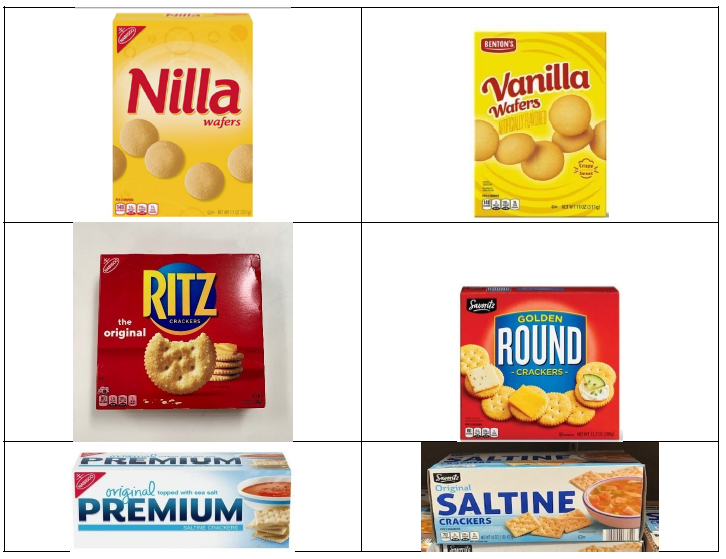
On May 27, 2025, Mondelez International, Inc. sued Aldi, Inc. for “use of private label product packaging that blatantly copies and trades upon the valuable reputation and goodwill ” of Mondelez. See 25-cv-05905 now pending in the Northern District of Illinois. The Four Count Complaint for Federal Trade Dress Infringement, Federal Trademark Dilution, Unfair Competition, Dilution, provides this comparison between Mondelez’ and Aldi’s products:

Private label (aka store brand) products often copy elements of the national brands packaging, to convey a message of equivalence and to invite comparison, but sometimes the private label can go too far. What the Norther District of Illinois will have to sort out is whether Aldi has gone too far with its packaging.

Mondelez will have to show that Aldi’s packaging infringes Mondelez’ trade dress — that combination of non-functional packaging features that consumers rely upon to find the products they want. Mondelez’ burden may be made more difficult by Aldi’s modus operandi. As reported on foodindustrynetwork.com “Aldi dominates in private-label share for grocery, household, and health and beauty products, which account for more than three-quarters (77.5%) of its total sales, Numerator’s private-label trend tracker shows. Roughly 90% of the items in Aldi’s stores are own brands.” (https://foodindustrynetwork.com/aldi-leads-in-private-label-volume-growth/) In an environment where 90% of the items are Aldi’s brands, is any Aldi customer really confused about what they are getting?

If Aldi’s chose to convey its message of equivalence with different packaging with a written “Compare to” message would Mondelez be any less unhappy? Yes, there are similarities in the packages, but we will have to wait to see whether Mondelez can show that Aldi’s has gone too far.

An Award of Defendant’s Profits, Does Not Include Defendant’s Affiliates’ Profits

In Dewberry Group, Inc. f; Dewberry Engineers Inc., — US — (2025), the Supreme Court made the unremarkable decision that an award of a defendant’s profits under 15 USC 1117(a), is limited to the named defendant, and not to unnamed affiliates of the defendant.

The district court had held that considering the actual defendant and its affiliates together would prevent the “unjust enrichment” that the Act was meant to target and totaled the affiliates’ profits from the years Dewberry Group infringed, resulting in An award of nearly $43 million. Reiterating the “‘economic reality’ of Dewberry Group’s relationship
with its affiliates,” the Fourth Circuit approved the treatment of all the companies “as a single
corporate entity.” holding Dewberry Group to account for its use of infringing materials to generate corporate profits.

Noting that the Lanham Act authorizes the recovery of the defendant’s profits, the Supreme Court said that in the absence of a specific definition, the word “defendant” bears its usual legal meaning: “the party against whom relief or recovery is sought in an action or suit,” i.e. the Dewberry Group. The Court observed that the plaintiff chose not to add the Group’s property-owning affiliates as defendants, and thus the affiliates’ profits are not the (statutorily
disgorgable) “defendant’s profits” as ordinarily understood.

The Supreme Court said that background corporate law principles do not change the result, for it is long settled as a matter of American corporate law that separately incorporated organizations are separate legal units with distinct legal rights and obligations — even if they are affiliated. Noting that Dewberry Engineers admitted it never tried to make the showing needed for veil-piercing, the Court said that the need to respect corporate formalities remains..

Plaintiff attempted to support the award by invoking a later sentence in Section 1117(a): “If the court shall find that the amount of the recovery based on profits is either inadequate or excessive[,] the court may in its discretion enter judgment for such sum as the court shall find to be just, according to the circumstances.” Plaintiff argued that a court can
consider “as relevant evidence” the profits of related entities— for example, to see if the defendant diverted some of its earnings to an affiliate’s books. But the Supreme Court said that this is not what was done:

The District Court did not rely on the just-sum provision, or suggest that it was departing up from Dewberry Group’s reported profits to reflect the company’s true gain. There was no two-step process for deciding on the award, but only a single step: the calculation of the “defendant’s profits.”

The Court added that that treatment, by its terms, disregards “corporate formalities”—and likewise the “principle[] of corporate separateness.”

The Supreme Court thus vacated the judgment of the Fourth Circuit, and remanded the case for further proceedings, expressly leaving open the question of the effect of the “just sum” provision when properly applied, and whether veil-piercing is an available option on remand,

CoorsTek in the Pink as CeramTec’s Trademark Registrations Get Pink Slips for Functionality

In CeramTec GmbH v. CoorsTek BIoceramics LLC, [2023-1502[(January 3, 2025), the Federal Circuit affirmed the TTAB’s cancellation of CeramTec’s trademark registrations on the pink color of ceramic hip components.

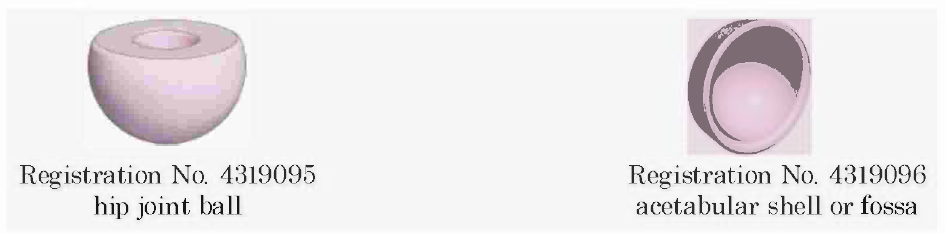
CeramTec manufactures artificial hip components used to replace damaged bone and cartilage in hip replacement procedures. The hip components are made from a zirconia toughened alumina (“ZTA”) ceramic originally developed for use in cutting tools. The ZTA ceramic contains, among other things, chromium oxide (chromia). The chemical composition of CeramTec’s products was the subject of CeramTec’s U.S. Patent 5,830,816 until January 2013, when the patent expired. The ’816 patent’s specification and prosecution history discuss how adding chromia enables the claimed composition to obtain unprecedented levels of hardness. Increased hardness levels enable the ZTA hip component to maintain its shape and resist deformation. The range of chromia claimed in the ’816 patent can produce ZTA ceramics in a variety of colors, such as pink, red, purple, yellow, black, gray, and white. CeramTec’s components contain chromia at a 0.33 weight percentage, which makes it pink.

A year before the expiration of its patent, CeramTec applied for two trademarks claiming protection for the color pink used in ceramic hip components, and two registrations issued on the Supplemental Register in April 2013:

:.

CoorsTek manufactures two ZTA ceramic materials for hip implants: (1) CeraSurf-p, which contains chromia, rendering it pink, and (2) CeraSurf-w, which does not contain chromia,
rendering it white. On March 3, 2014, CoorsTek filed a lawsuit in the District of Colorado and a cancellation petition with the Board, both seeking to cancel CeramTec’s trademarks on
the ground that the color pink claimed was functional.

At the Board, CeramTec argued that although it had once believed that adding chromia
provided material benefits to ZTA ceramics [upon the expiration of their patent] they discovered this belief was mistaken and has since been disproven. The Board nonetheless found in favor of CoorsTek and concluded that the color pink was functional as it relates to ceramic hip components. In doing so, the Board rejected CeramTec’s unclean hands defense, in which CeramTec argued that CoorsTek should be precluded from petitioning to cancel its trademarks on functionality grounds because CoorsTek had previously contended that chromia provided no material benefits to ZTA ceramics.

On appeal, CeramTec raised two main arguments: (1) that the Board’s finding that its trademarks are functional was infected by legal error and unsupported by substantial
evidence, and (2) that the Board erred by categorically precluding the defense of unclean hands in cancellation proceedings involving functionality.

The Federal Circuit noted that the Board analyzed the functionality of CeramTec’s trademarks in part under the four factors set out in Morton–Norwich:

(1) the existence of a utility patent disclosing the utilitarian advantages of the design;
(2) advertising materials in which the originator of the design touts the design’s utilitarian
advantages;
(3) the availability to competitors of functionally equivalent designs; and
(4) facts indicating that the design results in a comparatively simple or cheap method of
manufacturing the product.

Under the first Morton-Norwich factor, the Federal Circuit noted that the Board considered the claims, specification, and prosecution history of the ’816 patent to disclose the “functional
benefits of chromia with respect to the toughness, hardness, stability and suppression of brittleness of the ZTA ceramic.” The Board also considered CeramTec’s other patents and applications. Finally, the Board considered CeramTec’s concessions that the addition of
chromia causes ZTA ceramics to become pink and that CeramTec’s products practice at least one claim of the ’816 patent.

CeramTec contended that it was error for the Board to find that the patents disclose that chromia provides utilitarian advantages to ZTA ceramics in addition to increasing hardness, but CeramTec’s admission that it did increase hardness was enough for the Federal Circuit. The Federal Circuit als rejected the assertion that the Board misapplied TrafFix because its patents do not explicitly disclose material benefits for pink ZTA ceramics and do not discuss hip components, only cutting tools, noting nowhere does TrafFix hold that for a patent to be evidence of a claimed feature’s functionality, the patent must explicitly disclose that the claimed feature is functional. Nor does TrafFix state that for a trademark to be subject
to a TrafFix analysis it must be used for the goods described in the patent.

Under the second Morton-Norwich factor the Board considered promotional and technical literature, as well as submissions made to the FDA, in which CeramTec stated that chromia provides various functional benefits to ZTA ceramics. CeramTec did not challege the second factor.

Under the third Morton-Norwich factor the Board recognized, there was no “probative
evidence” that different-colored ceramic hip components were “equivalent in desired ceramic mechanical properties to those of CeramTec’s products. The Federal Circuit agreed, noting that for the third factor to weigh in favor of nonfunctionality, there must be evidence of actual or potential alternative designs “that work equally well” to the trademarked design. CeramTec argued that statements by CoorsTek about its white ceramic components and the’816 patent’s disclosure of ZTA ceramics in a variety of colors in addition to pink showed non-functionality, but the Federal Circuit did not find the evidence undisputeddly provide that CoorsTek’s white ceramic was better than CeramTec’s products. The Federal Circuit found that CeramTec’s arguments amount to a disagreement with the weight the Board assigned to the evidence, which it saw no reason to disturb.

Finally, under the fourth Morton-Norwich factor, the Board found this factor factor—whether the design results in a comparatively simple or cheap method of manufacturing the product—to be neutral. CeramTek argued that the Board overlooked undisputed evidence, but the Federal Circuit found that CeramTec mischaracterized the evidence as undisputed, and in light of the conflicting evidence, the Board reasonably found the factor to not weigh for or
against functionality.

On the issue of unclean hands, CeramTec argued to the Board that CoorsTek should be precluded from asserting that CeramTec’s trademarks are functional because CoorsTek had long expressed the opposite: that chromia provides no material benefits for ZTA ceramics. The Board disagreed, holding that the unclean hands defense is unavailable in Board functionality proceedings in view of the prevailing public interest in removing registrations of functional marks from the register and finding CeramTec’s unclean hands defense inapplicable.

The Federal Circuit agreed that the Board spoke too strongly by suggesting that the unclean hands defense was categorically unavailable in functionality proceedings, noting that the Board’s rules explicitly provide that the registrant in cancellation proceedings before the Board, may include the affirmative defense of unclean hands. However, the Federal Circuit said that it was not clear that the Board intended to announce a broad policy, as its conclusion is preceded by reference to its “discretion,” which is generally exercised case-by-case, and the Board did not designate its decision as precedential. If, however, the Board intended to bar an unclean hands defense from all functionality proceedings, the Federal Circuit said that would be error, but any such error was harmless in the present case because the Board adequately considered whether the unclean hands defense was available in this case, as illustrated by its statement that it was exercising its discretion in view of the “strong public policy interest in cancelling ineligible marks.

.

.

,